


Wedding Design Budget: How Much Do Flowers, Lighting, Stationery and Décor Cost?

When couples start planning a destination wedding in Italy, it is easy to focus on the most obvious expenses: the venue, catering, photography and entertainment.
Yet there is another important part of the wedding budget that has a major impact on the final result: wedding design.
Lighting, flowers, stationery and décor are not simply decorative elements added at the end of the planning process. They are part of a visual concept that needs to work with the couple, the season, the venue, the available spaces and the way guests will experience the wedding.
The wedding design budget can therefore vary significantly depending on the look and atmosphere you want to create, the characteristics of your venue and the level of customization involved.
If you are building the overall budget for your destination wedding in Italy, I recommend starting with my complete guide, How Much Does a Wedding in Italy Cost?, where I cover the main wedding expenses you should consider when planning a wedding in Italy.
And before diving into the individual wedding expenses, start with the bigger picture: read my guide on “Wedding Budget: How to Plan Your Spending Without Losing Control” to understand how to set your overall budget, define your priorities and keep your spending under control.
Wedding Design Budget: Why Lighting, Flowers and Details Matter
The wedding images we fall in love with rarely show all the work behind them.
We see a dinner illuminated by hundreds of candles, a historic villa enhanced by carefully planned lighting, beautifully layered tablescapes, a ceremony surrounded by greenery or a perfectly coordinated stationery suite.
What we don't see are the hours of design work, site inspections, planning, transportation, professional teams, installation and breakdown.
The wedding design budget therefore includes much more than buying flowers or adding a few decorative elements.
Every decision should start with a simple question: what do we want our guests to experience, and what atmosphere do we want to create?
A highly distinctive venue, for example, may require a completely different approach from a more neutral space. An outdoor dinner, a party inside a historic building or a sunset cocktail reception will all have different technical and design requirements.
This is why I don't believe in adding décor simply because “we need flowers” or because “the venue needs lighting.” The concept comes first. The solutions come afterwards.
Lighting Design: Light Is Part of the Wedding Design
Lighting is probably one of the most underestimated expenses when couples build their wedding budget.
And yet, especially for destination weddings in Italy, it can completely transform the way a space is perceived.
A villa, garden, cloister or terrace can look spectacular during the day and completely different after sunset. A good lighting designer does not simply “put up lights.” They study the architecture, perspectives, guest viewpoints and the way each space will be used throughout the evening.
A lighting project may include:
architectural lighting for the façade or key elements of the venue;
lighting for trees, gardens, pathways and outdoor areas;
atmospheric lighting for the dinner tables;
decorative and technical lighting for the dance floor;
lighting for lounges, bars, cake tables and other areas;
different lighting solutions for cocktails, dinner and the party;
lighting control and technical management throughout the event.
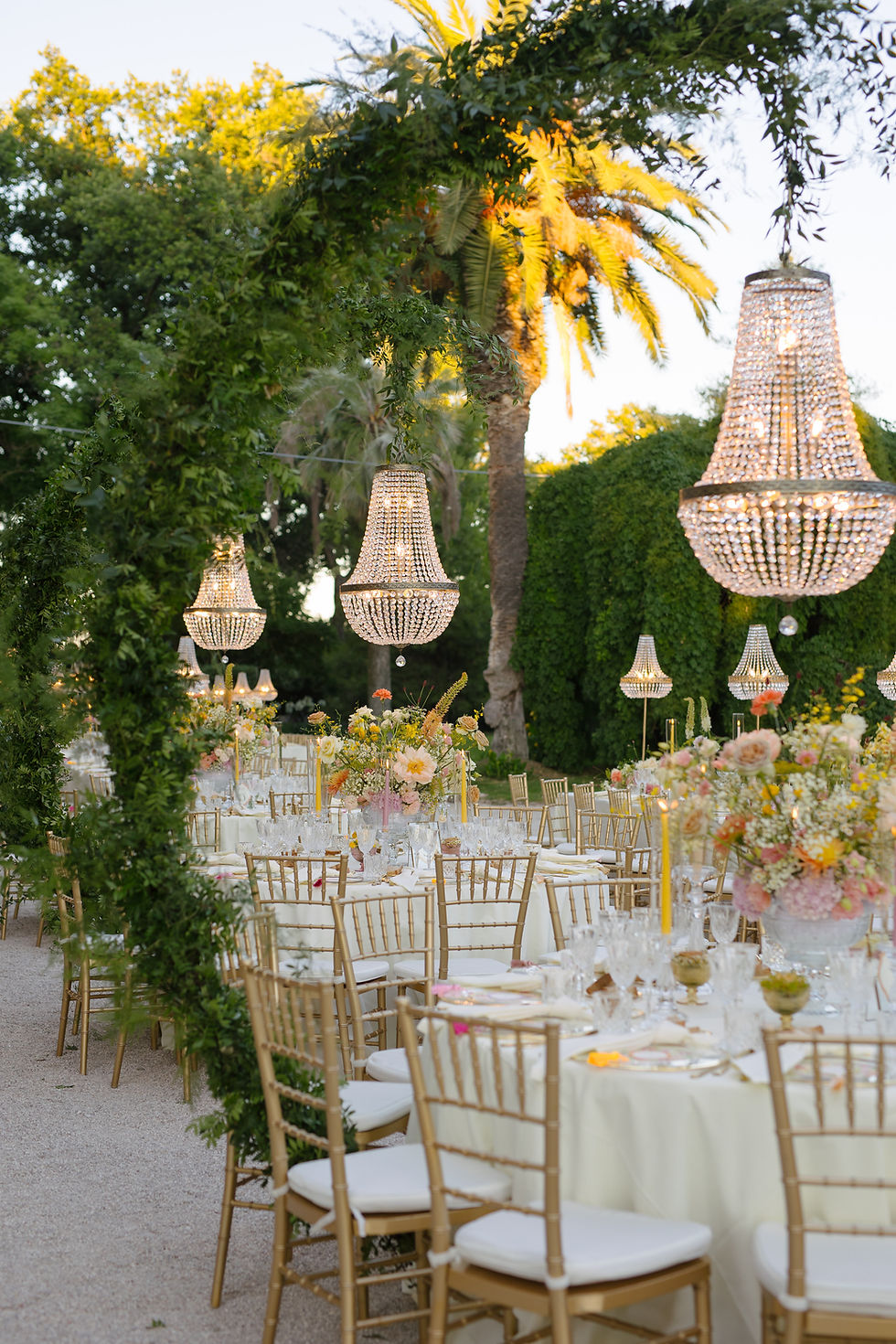
An experienced, well-equipped lighting designer can also provide alternative solutions depending on the venue.
Not every Italian wedding venue has the same technical possibilities, power sources or restrictions. This is where experience becomes particularly valuable: finding a solution that enhances the space without forcing it to become something it is not.
In my main guide to the cost of a destination wedding in Italy, I currently suggest an indicative starting range of around €2.000, potentially exceeding €5.000, for architectural or scenic lighting, depending on the size of the venue, the number of areas involved and the technical complexity of the project.
There is another aspect I consider important: when the project requires it, I prefer the lighting designer to be present during the wedding itself.
This is not simply about aesthetics. Having the professional on site means that the lighting can be monitored throughout the evening and that any unexpected issue can be addressed quickly.
Flowers, Stationery and Décor: Creating a Cohesive Visual Story
Flowers are often the first thing couples think about when they consider wedding décor, but the work of a professional floral designer goes far beyond choosing flowers and colors.
A floral concept usually begins with a mood board created specifically around the couple, the season, the venue and the atmosphere they want to achieve.
And it includes much more than the bouquet.
The wedding design budget can include:
personal floral accessories such as the bouquet, boutonnière and other details;
ceremony floral arrangements;
reception and table arrangements;
different areas of the venue, such as the welcome area, lounge, bar and cake table;
decorative and scenic elements such as vases, candelabras, candles, structures and other objects;
design, preparation, transportation, installation and breakdown.
A talented floral designer does not work only with colors. They work with proportion, volume, texture, shape and scale. They know when a flower should be the protagonist and when it should complement the architecture without overwhelming it.
This is particularly important in Italy, where many wedding venues already have a strong identity. A castle, historic villa, medieval borgo or countryside estate will not require the same type of floral intervention.
Logistics also play an important role. Even for a medium-sized or relatively intimate wedding, a floral team may consist of several professionals, together with transportation, often requiring refrigerated vehicles, studio preparation and hours of installation on site.
The same level of care should be given to stationery and graphic design.
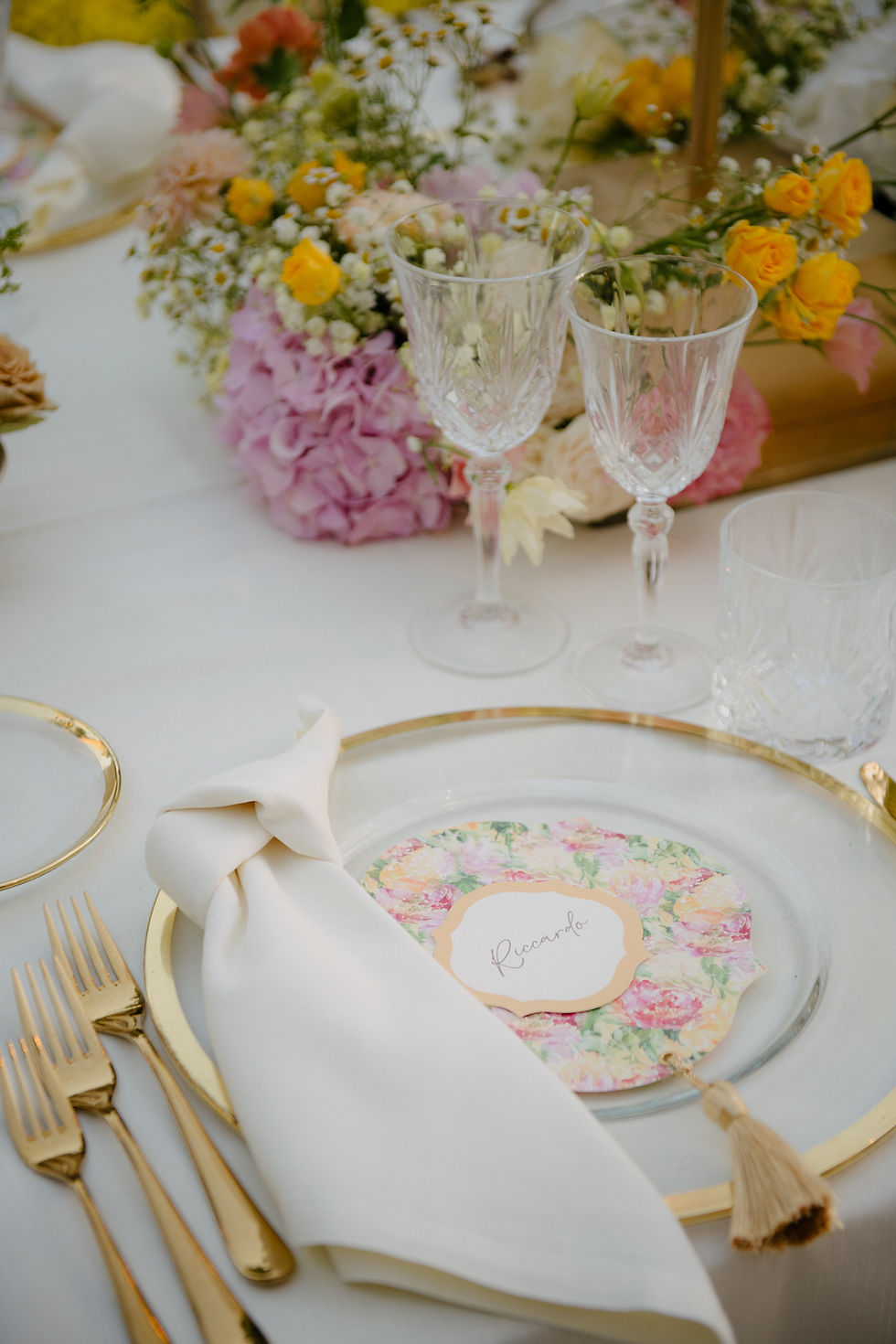
A well-designed wedding stationery suite is not simply about choosing a font and two colors. It is about creating visual continuity from the very beginning: from the save the date and invitation through the RSVP process, and then into the wedding day itself with ceremony programs, escort cards, menus, seating charts, maps, signage and other printed details.
There are many decisions involved: format, proportions, paper, texture, printing technique, materials, ribbons, envelopes, calligraphy, placement and the way each piece will be presented to guests.
Flowers, lighting and stationery are therefore not three separate worlds. Together, they create an important part of the wedding's visual identity.
How Much Should You Invest in Wedding Design?
There is no single figure that works for every wedding.
The budget depends on the venue, guest count, number of spaces to be designed, amount of customization and, above all, the level of transformation you want to achieve.
For flowers, for example, my main guide currently suggests an indicative starting range of around €2.500 for a more essential project, with more elaborate and scenic floral designs going beyond €4.500.
But the goal is not to reach a specific number.
The goal is to invest where it makes a difference.
A spectacular venue may require less floral décor and more investment in lighting. A more neutral space may benefit from a stronger floral concept. In some weddings, stationery can be intentionally understated; in others, it becomes an important part of the guest experience.
This is why, in my work, I don't start with a catalogue of decorations for couples to choose from. I start with the couple, the venue and the overall vision for the wedding.
My role is to help determine where an investment will genuinely add value and where it isn't necessary, avoiding expenses that do not contribute meaningfully to the experience.
At the same time, when a couple wants to achieve a certain level of aesthetic quality, I choose to work with professionals who can deliver it.
The images you see on my website and social media are not the result of improvised décor or choices made simply because they were the least expensive option. They are the result of a concept, specialized professionals and experienced teams who know how to turn an idea into something tangible.
For me, this does not mean spending without limits. It means spending thoughtfully, without compromising the level of quality required to achieve the desired result.
Because the most successful wedding design is not necessarily the one where the most money was spent.
It is the one where every element was chosen because it had a reason to be there.
If you are planning a destination wedding in Italy and would like professional guidance, you can learn more about my wedding planning services in Italy here.
And if you need to talk to me, if you want to know more about how I work and what I can do for you, what are you waiting for?
Finally, if you haven't yet:
Discover Destination Wedding in Italy: How to Plan an Authentic and Refined Experience
Discover the complete guide to Getting Married in Italy
Discover how to choose an Italy Wedding Planner
Discover how much a Wedding Planner costs in Italy
Discover how much a Destination Wedding in Italy costs. The definitive guide
Discover the INVESTMENT & VISION for a destination wedding in Italy
Why choose LE MARCHE for your destination wedding in Italy
Why choose ROMAGNA for your destination wedding in Italy
Why choose UMBRIA for your destination wedding in Italy
Why choose ABRUZZO for your destination wedding in Italy
View my real weddings planned in Italy
EnJoy!
Federica
Your Planner in Romagna, Marche, Umbria & Abruzzo


